
Effective Warehouse Inventory Control using Warehouse Racking
Within a space-constrained hub by Changi, a lean 3PL crew implemented a major shift. Overnight, they moved from floor block-stacking to a rack layout. That decision opened up aisles, helped improve driver safety, and shortened the time spent locating pallets.
In a few weeks, cycle counts sped up and they deferred expensive floor expansion. This practical solution is beneficial for anyone looking to maximize warehouse space with racking.
Racking turns warehouse height into orderly locations. They enable smoother flow and precise counting for https://www.ntlstorage.com/racking-system-reconfiguration. For Singapore operators, where land is expensive, these systems are essential for efficient inventory storage solutions.
The primary goals of racking systems include optimising storage space, simplifying goods movement, and boosting supply chain efficiency. Key benefits include better accessibility for forklifts and pallet jacks, reduced clutter and load-fall risks, flexibility for mixed SKUs, and the ability to scale as inventory changes.
Getting racking right blends assessment, layout design, buying, and installation. It also involves clear labelling and staff training. This ensures racking-based inventory control delivers real improvements. It often postpones costly facility expansion.
Racking systems: what they are and why they matter in Singapore
Grasping racking fundamentals lets teams optimize space and flow. It’s a framework of racks and shelving in warehouses, distribution centers, and industrial facilities. It leverages vertical height to organise and store goods efficiently. Robust systems increase picking velocity, clarity, and safety.
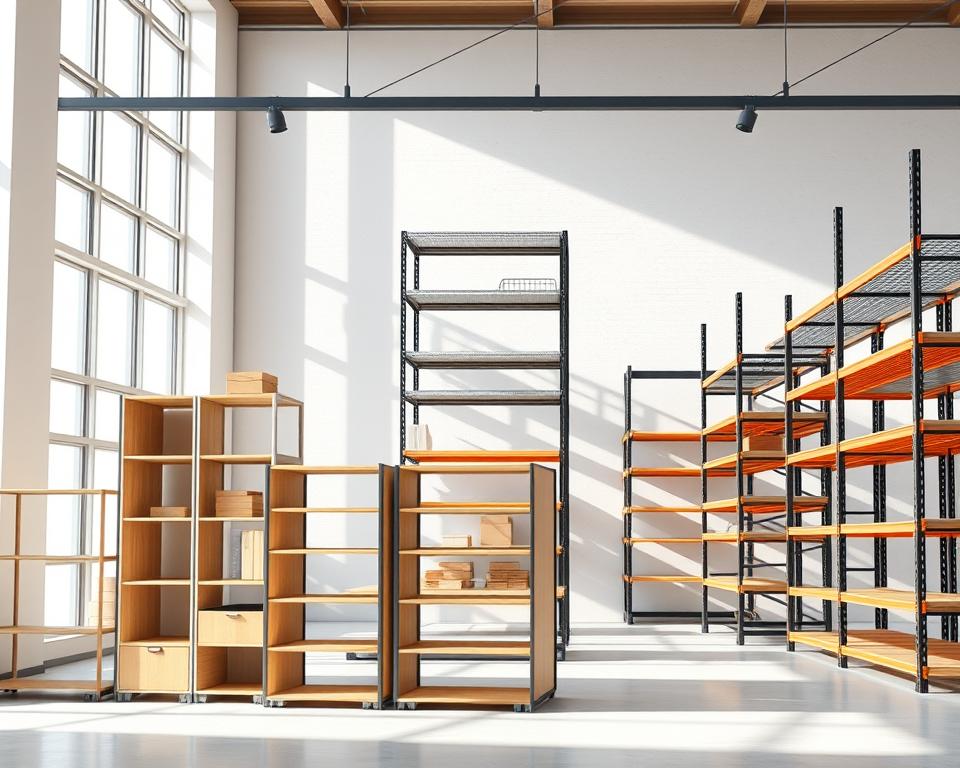
Definition and core components
Common parts are uprights, beams, decking, and supports. They assemble into bays with beam tiers that mark positions. Match parts to load types and adjust as needs change.
Role in modern warehousing and supply chains
Racking systems are vital for efficient inventory management by assigning specific locations for SKUs. It accelerates counting and helps improve pick precision. Many sites pair racking with barcode/RFID and WMS for live visibility. This combination boosts throughput and supports various picking methods, impacting order fulfillment speed.
Singapore context: space constraints and racking
In Singapore, maximizing vertical capacity is critical due to limited real-estate and floor area. High-density solutions like drive-in and pallet flow reduce aisle needs and increase storage density. A balanced mix maintains selectivity and density, using space efficiently without sacrificing safety.
Racking types and how to choose the right setup
Picking the right racking underpins efficient warehousing. We outline how rack design shapes day-to-day performance. It covers common types, inventory fit, and Singapore-focused costs.
Rack types overview
Selective pallet racking is the most common choice. Operators can access each pallet directly from an aisle. It fits fast-moving SKUs and adaptable layouts. Costs range from $75 to $300 per pallet position.
Drive-in and drive-thru racking offer high-density storage by letting forklifts enter rack lanes. They suit bulk, low-variability storage and cut aisle count. Costs range from $200 to $500 per pallet position.
Cantilever racking uses arms to hold long or odd-shaped items such as lumber and pipes. No front columns obstruct loading. Expect about $150–$450 per arm.
Pushback racking stores multiple pallets per depth on carts or rails. Density increases https://www.ntlstorage.com/racking-system-load-management-guide-safe-and-efficient-storage/ while maintaining access to the last-in pallet. Costs run $200–$600 per position.
Pallet flow employs sloped rollers to enforce FIFO. It suits perishable goods and expiry-managed stock. Costs commonly fall between $150 and $400 per pallet position.
Automated Storage and Retrieval Systems (AS/RS) and robotics vary widely in price. They deliver dense storage, higher speed, and robust WMS ties. AS/RS cost depends on desired throughput, automation depth, and site complexity.
Fit rack types to SKU profiles
Consider size, mass, turns, and lift equipment in selection. For high velocity/mixed SKUs, choose selective or AS/RS with pick access. This enables efficient storage and faster pick cycles.
Large, long, or irregular goods fit cantilever racks. This keeps aisles clear and reduces product handling time. Matching rack type to inventory avoids damage and speeds loading.
For FIFO-critical stock such as food and pharmaceuticals, pallet flow systems keep expiry order automatically. They become a key tool in regulated product management.
Bulk, low-variety SKUs work well in drive-in/drive-thru/pushback. These options maximise usable space so operators can store more while managing inventory with racking systems designed for density.
Cost considerations per rack type
Budgeting goes beyond unit pricing. Base racking system cost is a starting point. Add installation labour, anchoring, decking, pallet supports, and safety accessories. Don’t forget engineering, inspections, and training.
Compare typical unit ranges: selective ($75–$300 per pallet position), drive-in ($200–$500), cantilever ($150–$450 per arm), pushback ($200–$600), pallet flow ($150–$400), and AS/RS (wide variation). Weigh cost factors for https://www.ntlstorage.com/racking-system-small-warehouses/ with lifecycle expenses.
Factor in floor reinforcement, delivery, and possible downtime during installation. Over time you get better utilisation, faster picks, and fewer damage incidents. These gains often justify higher upfront investment.
| Rack Type | Ideal Use | Unit Cost Range | Main Advantage |
|---|---|---|---|
| Selective | High-turnover, varied SKUs | \$75–\$300/position | Full selectivity for speed |
| Drive-in/Drive-thru | Homogenous bulk | \$200–\$500/position | Fewer aisles, higher density |
| Cantilever system | Timber, pipe, long goods | \$150–\$450 per arm | No front columns; easy loading of long items |
| Push-back | Higher density with easy access | \$200–\$600 per pallet position | Multi-deep storage and simple retrieval |
| Gravity flow | Expiry-controlled goods | \$150–\$400 per pallet position | Built-in FIFO rotation |
| AS/RS + Robotics | High-volume automation | Varies widely by automation level | Max density and speed with WMS |
managing inventory with racking systems
Logical fixed locations make tracking easier. Assign each SKU a specific slot based on its master data. It reduces misplacement and speeds retrieval, enhancing inventory management.
Organize SKUs by turnover, size, and compatibility. Use ABC zoning to place fast movers. Place high-velocity SKUs at ideal heights to reduce travel and increase pick speed.
Select stock rotation methods that align with product life cycles. Use gravity flow or tight putaway rules to enforce FIFO for perishables. For dense, LIFO-friendly operations, consider pushback or drive-in racking.
Use rack addresses in daily control. Conduct cycle counting at the rack level and perform physical slot audits to resolve discrepancies. Link count results to the WMS to maintain accurate master records.
Optimize pick paths and staging areas to decrease travel time and handling errors. Match rack height to truck reach and operator ergonomics for safety and efficiency. Train staff on capacities, pallet seating, beam clips, and clearances.
Measure picks per hour, putaway time, cube utilisation, accuracy, and rack impacts. Review trends weekly to spot improvements.
Define SOPs, refresh training, and apply visual cues to keep standards. When staff understand limits and proper placement, inventory control using racking becomes a routine, reliable, and measurable process.
Design, loading, and installation: best practices
A robust racking design starts with a detailed site survey. Collect details on inventory, trucks, heights, columns, and floor capacity. This groundwork is critical to optimizing space. It underpins safety and efficiency.
Assessment & layout planning
Start by mapping SKU velocity using ABC analysis. Locate fast movers near dispatch in accessible zones. Assign deep lanes to slow-moving bulk. Balance aisle width for safe forklift operation with storage density.
Ensure circulation covers exits, sprinklers, inspection clearance. Bring engineers and trusted vendors in early. This alignment fits building constraints and meets local codes.
Load capacity & shelf calculations
Calculate shelf loads based on material, shelf dimensions, and support spacing. Apply manufacturer load tables plus safety factors. Check beam deflection limits and allowable surface loading per pallet.
Check slab capacity for heavy or point loads. Engage engineers for reinforcement options when required. Post visible load ratings per bay and train staff accordingly. Routine checks prevent overstress on uprights/beams.
Accurate load calcs uphold compliance and mitigate collapse risk.
Procurement and installation checklist
Use a checklist to confirm type, bay size, finish, and accessories. Include certificates of compliance and warranty terms.
| Phase | Checklist Items | Involve |
|---|---|---|
| Planning phase | Profiles, aisle sizing, egress, zoning | Ops lead, planner, structural engineer |
| Engineering | Load ratings, deflection, slab capacity | Rack vendor engineer, structural engineer |
| Procurement step | Rack type, bay height, finish, accessories, compliance docs | Procurement, vendor, safety |
| Install | Prep site, anchor uprights, fit beams/decking, ties | Certified installers, site supervisor |
| Verification/QA | Plumb uprights, beam clips, clearance checks, signage | Inspector, safety, engineer |
| After install | Initial engineering inspection, register with authorities, as-built drawings | Engineer, compliance, maintenance |
Follow installation best practices: clean and level floors, mark bay positions, anchor uprights, and install beams per vendor specs. Install decking/supports and use ties where necessary. Check clips and plumb, then post visible capacities.
After installation, provide training on managing inventory with racking systems, safe loading, and damage reporting. Keep records of as-built drawings and inspections to support maintenance and future upgrades.
Organisation, labelling, and tech for inventory control with racking
Clear organisation and uniform labels reduce mistakes and smooth operations. Start with a logical, unique ID scheme for each area. Ensure the format is intuitive for pickers and aligns with your Warehouse Management System (WMS).
Utilise durable labels, barcodes, and RFID tags at eye level on each bay and beam. Show SKU, max capacity, and handling notes. Standardised labels help improve control and reduce new-hire training time.
Scanning via barcode/RFID speeds counts and real-time updates. Scanning at putaway and during picking ensures stock levels are accurate. This practice integrates inventory control with warehouse management, reducing discrepancies during audits.
Picking strategy drives arrangement. Use zone picking to allocate areas. Batch picking aggregates SKUs across orders. Wave picking schedules orders by departure time. Use PTL/PTL systems for fast movers to help improve efficiency.
Optimise routes and keep fast movers near pack. Set dedicated faces and lanes for leaders. Use gravity flow for perishables to maintain FIFO and lower waste.
Track KPIs such as pick accuracy, picks per hour, and travel time. Rebalance locations/allocations based on data. Small, frequent tweaks drive ongoing optimisation.
For WMS integration, track bay/level/position in software. Configure the system for location hierarchies, pick strategies, replenishment rules, and expected pick paths. Align digital instructions with physical layout.
Automation and racking systems can significantly increase throughput in high-volume operations. Consider shuttles, AS/RS, or AMRs for dense, fast sites. Integrate automation with barcode/RFID and WMS for accurate, real-time control.
Racking safety, maintenance, and compliance
Safety starts with visible load limits and safeguards. Label every bay with its rating. Install beam clips/backstops/supports to prevent movement. Maintain clear aisles and marked egress paths.
Regular maintenance cuts risk and downtime. Conduct weekly visual checks for damage, displacement, or anchor failures. Arrange qualified inspections and maintain logs. This supports audits and insurance reviews.
When damage occurs, immediately take affected bays out of service until repairs are done. Tighten anchors, replace missing safety clips, and re-label worn signage promptly. Formal reports accelerate fixes and reduce recurrence.
Compliance in Singapore requires meeting local safety rules and codes. Use international standards like OSHA where applicable. Train on safe stacking, load limits, and incident reporting. This builds a safety culture that lengthens rack life and supports maintenance/compliance.
Common Questions
What is a warehouse racking system and why does it matter for Singapore warehouses?
A racking system is a structure that expands storage. It uses uprights, beams, and wire decks. In Singapore’s tight, high-cost environment, it’s essential. It allows for efficient use of space, delaying the need for expansion and reducing costs.
Which parts make up a racking system?
Key components are uprights, load beams, and wire decks. Together they form a structured storage system. They shape bays and access for safe, efficient storage.
How do racking systems improve warehouse inventory management?
Racking helps by providing fixed locations. It improves accuracy and lowers shrink. They enable quicker fulfillment and live tracking support.
Common racks and how to choose
Selective PR and drive-in/thru are widely used. Use selective for access; drive-in for bulk density. The choice depends on the type of inventory and handling needs.
How should I match rack type to my inventory profile?
Match rack type to your inventory based on size, weight, and turnover. Use selective racking for high-turnover items. Bulk loads suit drive-in or pushback. Verify truck compatibility and aisle width.
Typical rack cost ranges?
Costs differ by type and complexity. Selective typically \$75–\$300. Drive-in runs \$200–\$500. Automated systems have variable pricing based on throughput and integration needs.
Pre-install planning steps?
Start with a thorough assessment of your inventory and building constraints. Include velocity and aisle width. Engage structural engineers and racking vendors to ensure compliance and proper installation.
How are load capacities and shelving calculations determined?
Loads hinge on material and size. Manufacturers provide load tables to guide calculations. Display limits and confirm slab capacity for heavy points.
What should a procurement and installation checklist include?
Confirm type, size, and capacities. Include accessories and compliance docs. Install per spec and arrange inspections.
Organising, labelling, and tech integration?
Implement a standardised numbering scheme for racking. Use durable labels and integrate with WMS for real-time inventory updates. This supports accurate slotting and automated picking.
What picking methods work best?
Pair zone picking with selective racking for speed. Apply flow racks for FIFO. High-throughput SKUs benefit from automated systems. Plan paths to cut travel.
How to trade off density vs access?
Balance based on velocity and access. Use selective racking for high-turnover items and dense solutions for bulk storage. Keep fast in selective, slow in dense.
Essential racking safety and maintenance?
Publish capacities and install safety hardware. Inspect regularly and repair promptly. Keep aisles/egress clear. Document inspections/repairs for audits/insurance.
Which regulations matter in Singapore?
Comply with local workplace safety standards and building codes. Engage structural engineers and registered vendors. Adopt recognised best practices and maintain records.
How does racking support inventory control and stock rotation?
Fixed locations increase accuracy. Apply FIFO or putaway rules. Organized zones and clear labels support expiry management for perishables.
Key metrics after installing racks?
Track order pick rate, putaway time, and space utilisation. Measure accuracy of inventory and picks. Use metrics to rebalance and gauge ROI.
When is automation the right move?
Consider automation for high throughput, labour costs, or space constraints. Shuttles and AS/RS provide dense, rapid handling. Evaluate lifecycle costs and integration before committing.
How should we train staff for racking?
Train staff on load limits, correct pallet placement, and damage reporting. Offer post-install training and refreshers. Build a culture encouraging immediate impact reports.
What should be included in recordkeeping and documentation?
Keep as-builts, load calcs, and vendor tables. Maintain inspection/maintenance logs, certificates, and training files. These records support audits, insurance, and lifecycle planning.